It can be surprisingly difficult to identify MTG card sets. Lets start with a useful resource; The MTG Fandom Wiki (loathe as I am to recommend a Fandom wiki) maintains a list of sets with expansion date, code, and symbols. This will be helpful in identifying the set for most cards.
The first step is identifying the card’s frame. There are 3 main frames that have been used; Original, Modern, and M15.
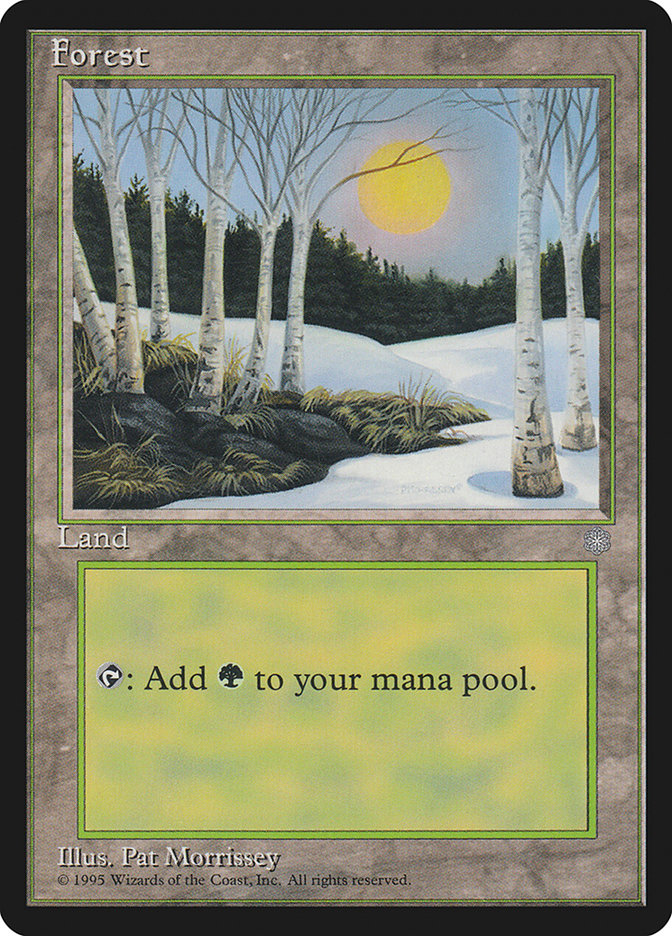
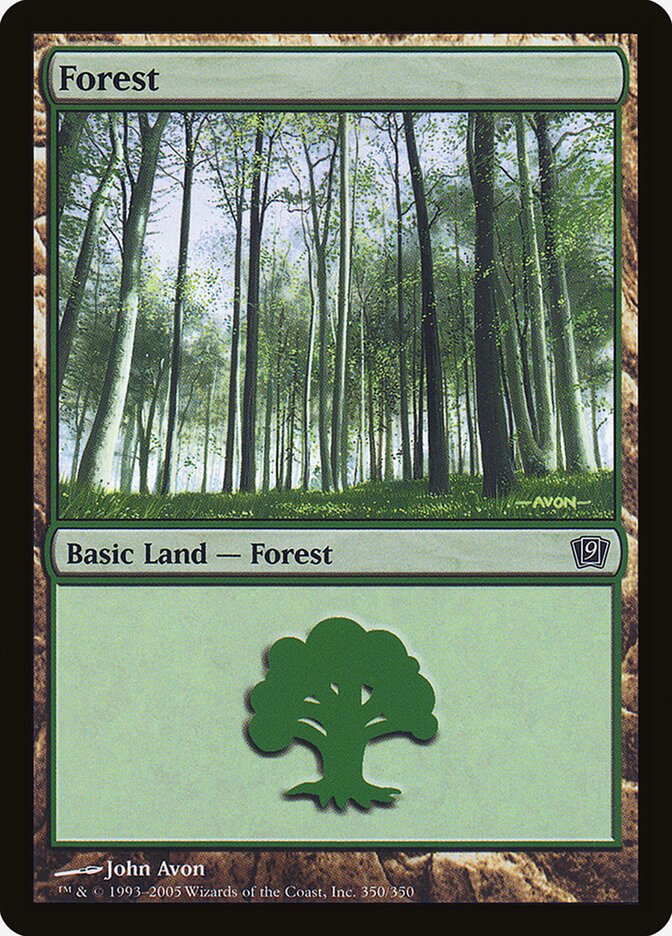
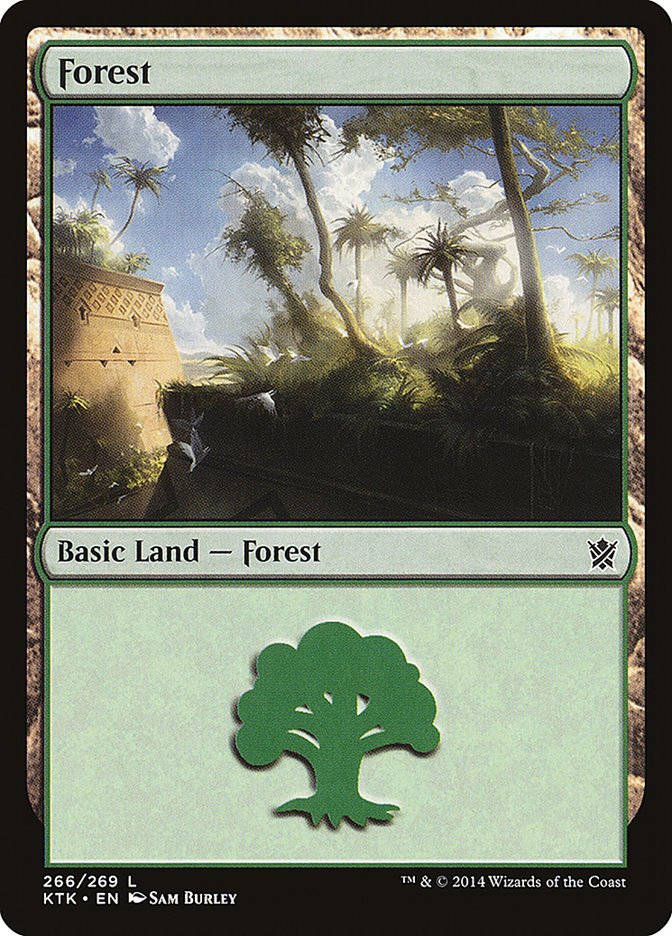
The Modern and M15 frames are quite similar, especially for common/uncommon cards. The easiest way to tell which you have is to look at the bottom portion of the frame. The M15 frame has a black background under the copyright and illustrator information.
M15 Framed Cards
If you have an M15 card, the copyright information includes a card number, set code, language code, and rarity. The card number and set code can be used to uniquely identify a card.
- Find the set code on your card
- Find that set code in the list of sets

In the case of this example, the card number is 266/269 (or just 266), the set code is KTK (Khans of Tarkir), the language code is EN (English), and the rarity is L (basic land).

In the case of this example, the card number is 0187, the set code is MKM (Murder at Karlov Manor), the language code is EN (English), and the rarity is R (rare). You can also see the holofoil stamp that is present on M15 frame rare and mythic rare cards.
Showcase cards can sometimes look a little different, but if this information is present in one of these formats at the bottom of the card, it is an M15 frame, and you can uniquely identify the printing of the card with the set code and card number.
Any card where the dot between the set code and language code is replaced with a star, is a premium card. Premium cards feature a different art, a different frame, or have a card treatment (eg foiling).
Alternatively, you can also use the set symbol. This is the primary method of identification for Modern Frame cards, soooo…
Modern Frame Cards
Most cards released prior to M15 (2014) still have card numbers, but do not have set codes to help identify them. This means that in order to uniquely identify a Modern Frame card, you will have to rely on the set symbol. There are a lot of sets for which this is true, but thankfully, the copyright date can be a big help.
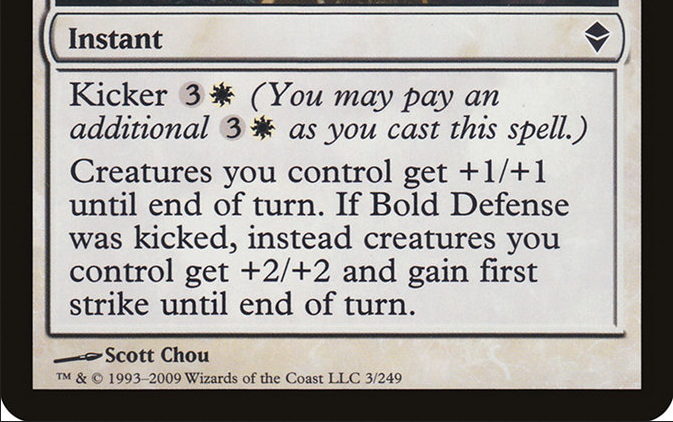
We can see that this card was printed in 2009, and has a card number of 3. Finding the year 2009 in the list of sets, we can see that this card must have come from one of the sets from Conflux to Premium Deck Series: Slivers, which is a list of 11 sets. This is much more reasonable to scan for the set symbol, and doing so, we can identify that this card came from the Zendikar set.
So, in summary
- Find the copyright year
- Find the sets that released in that year
- Compare the set symbol with those sets
Retro Frame Cards
The retro frame can be a lot tricker; some of the cards that were printed with this frame were printed long before the game had any meaningful standardisation. First, lets cover some milestones, so we know what to broadly look for.
Card numbers were introduced in the set Exodus, printed in 1998. Any set prior to this will not have card number information printed on it, so if you want to be sure of the order in a set, you’ll have to look it up by name and/or artwork. A general rule of thumb is that the cards are sorted by colour1, and then alphabetically within that colour.
Set symbols were always present on “Expansion” sets, but did not appear on “Core” set cards until 6th Edition in 1999. In the majority of cases, set symbols can be trusted, but there are exceptions.
Between Unlimited and Ninth Edition (so, with some overlap with the Modern frame), “reprint sets” had white borders. This was primarily present on Core Set cards2, but the white border also appeared on Chronicles. However, Renaissance, a “reprint set” printed in 1995, does not have a white border.
Now, lets look at how to actually identify the sets for these cards
Retro Frames with Set Symbols
If your retro frame card has a set symbol, you can almost always identify it by that symbol. As with the Modern frames:
- Find the copyright year
- Find the sets that released in that year
- Compare the set symbol with those sets
There are some exceptions, however.
If the card has the set symbols for Arabian Nights, Antiquities, Legends, or The Dark, and has a white border, it is from the set Chronicles.
Additionally, if the card is German or French, has a black border, and has the Arabian Nights, Antiquities, Legends, or The Dark set symbol, or has no set symbol and is Ironclaw Orcs or Twiddle, it is from the set Renaissance.
If the card is Italian, has a black border, and has the Arabian Knights or Antiquities set symbol, or is Ironclaw Orcs or Twiddle, it is also from Renaissance.
Renaissance was only printed in German, French, or Italian, so if your card is in any other language, you can ignore this set.
Retro Frames without Set Symbols
These are the tricky ones. Retro framed cards without set symbols are almost all Core Set cards, meaning they likely come from Alpha, Beta, Unlimited, Revised, Fourth Edition, or Fifth Edition.
Fifth Edition cards have no set symbol, a white border, and a copyright year of 1997.
Fourth Edition cards have no set symbol, a white border, and a copyright year of 1995
Revised (or Third Edition) cards have no set symbol, a white border, no copyright date, and the illustrator copyright is closer to the top edge of the bottom frame than it is to the bottom edge of the text box.
Unlimited (or Second Edition) cards have no set symbol, a white border, no copyright date, and the illustrator copyright is equidistant from the frame and the text box.
Unlimited and Revised are a pain in the arse to differentiate; there’s also a marked change in the saturation and text contrast between the two sets, but it’s difficult to identify this without having an example of each on hand. Thankfully, Scryfall has high resolution images of most cards.


Limited Edition Beta cards have no set symbol, a black border, and no copyright date.
Limited edition Alpha cards have no set symbol, a black border, no copyright date, and a much wider corner curve.


If your card has square corners, it is from either Collectors’ Edition or International Collector’s Edition.
There are some other frames from around this time that are tricker to identify. If you aren’t sure, try and find an expert or a long-timer; they’ll probably be able to help you!